
Maya agreed to talk on one condition: don't name her agency or the accounts she works on. "We're running campaigns for brands in overlapping categories," she said. "If people knew I had this kind of customer language database on their market too, it'd get complicated."
Maya is 29. Creative Strategist. Three accounts ranging from $200k–$400k/mo on Meta. Responsible for research, briefs, and concept development. And until about four months ago, she was spending roughly 4–5 hours per sprint doing manual platform sweeps that reset to zero the moment a new brief was opened.
"We weren't bad at strategy," she told me. "We were actually good at it. But half my week was going to the research step — YouTube tabs, Reddit threads, copy-pasting quotes into a Google Doc that started from scratch every two weeks. The intelligence never compounded. Every brief was essentially a fresh start."
Maya's First Sprint With the System
Verbatim customer quotes · first research session · 35 minutes
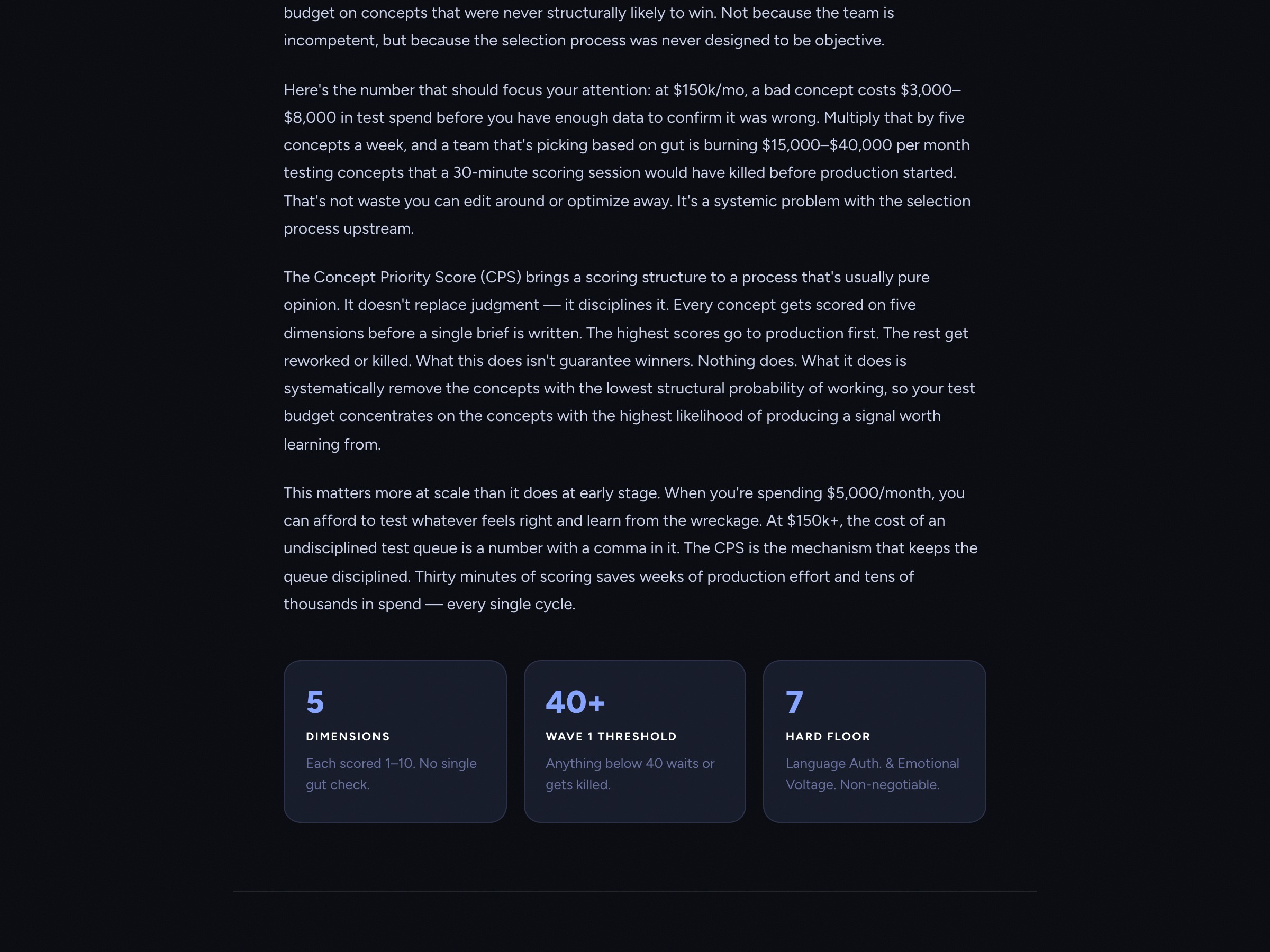
65% of backlog concepts killed by CPS before production.
Why Research That Resets Is a More Expensive Problem Than It Looks
The most exhausting part of Maya's job wasn't the strategy. It was the archaeology — digging through the same platforms, finding similar data, producing a slightly different brief for a slightly different sprint. Nothing compounded. The research "database" for Sprint 12 looked identical to Sprint 1: an empty Google Doc waiting to be filled.
"The real cost isn't the time," she said. "It's that the brief gets written on 20% of the available intelligence. The other 80% is sitting in a YouTube video you haven't watched yet, and a Reddit thread from three years ago that has exactly what your customer is feeling right now. But you don't have four more hours to find it."
The concepts that made it through weren't necessarily the strongest ones. They were the ones the team could build a narrative around given the research they actually had. Maya knew some of them were recycled angles. So did the client. But when research doesn't surface new territory, there's nothing to say about it. You brief what you can justify, not what the data would actually support.
The scoring problem was worse. Concepts got approved because someone felt strongly about them, not because they'd cleared a framework. And when a concept died in week two, there was no post-mortem data — no dimension-level feedback, no record of what the scoring would have caught. Just a Slack message saying "let's try a different angle."
The $29 Course She Almost Didn't Buy
Maya found it through a Slack community for performance creative professionals. Someone posted a link with a one-line note: "This is the only $29 thing that taught me to think about research as infrastructure instead of homework."
She read the sales page, told herself she'd come back to it, and closed the tab.
She came back four days later — at 11:40 PM, still in a YouTube rabbit hole that was producing diminishing returns, working on a brief due the next morning. Research she'd essentially done before, for a different account, in a document she could no longer find.
"I bought it mostly because I was frustrated," she said. "Not with the course. With what I was doing that night."
She went through Module 01 on Saturday morning. By Sunday afternoon, her research index had 240 verbatim customer quotes — from three platforms, sorted by emotional category. The first thing she thought: I've been manually doing a worse version of this for three years.
Her creative director's reaction when she showed up to Monday's brief with a searchable database of customer language: "She asked if I'd finally hired a researcher. I hadn't. I'd run a 20-minute AI sweep."
How Maya's First Week Actually Broke Down
- Day 1–2: Research Engine setup + first sweep 240 quotes
- Day 3: Backlog concepts run through CPS 65% cut
- Day 4–5: Three briefs from the index <45 min each
- Day 6–7: Scoring Boss set up + pipeline QC 0 unscored
Why This Works When Prompt Courses Don't
I've covered creative strategy long enough to watch a lot of "AI for creatives" content land and quietly disappear. The pattern is consistent: the prompts are good, the demos are impressive, and three weeks later the team is back to their old process. The prompts didn't replace a system — they accelerated a habit.
What's different here, Maya said, is the sequence.
"Most AI courses give you tools. This gives you a structure that the tools sit on top of. The research prompt works because the research INDEX is already built. The scoring works because the CRITERIA were defined before you started generating. You're not just using AI — you're using AI inside a system. That's why it doesn't revert."
The three-platform sweep (YouTube, Reddit, X) extracts verbatim customer language. The CPS framework scores concepts before production starts. The brief system translates the index into instructions. The Scoring Boss agent holds the QC standard without requiring a senior strategist to review every asset. Each layer feeds the next.
The AI isn't replacing the strategist. It's doing the mechanical work — the research sweep, the scoring math, the QC checklist — so the strategist can spend all their time on the judgment work: which insight is the nerve, which angle is differentiated, which hook lands for this audience in this moment. That's irreplaceable. The system gives it back.

The Velocity Gap
When I asked Maya what she'd say to someone who was skeptical about spending $29 on a creative system, she asked me a question instead.
"How many live ads is your best client running right now?"
When I estimated 30–40, she nodded.
"The brands at $400k-plus are running 400. Not because they have a bigger team. Because they have a faster creative loop. The research compounds. The briefs get sharper. The concepts that survive scoring are stronger. The production stops wasting budget on ideas that were always going to die. The whole pipeline moves faster. And every sprint, the gap between the brands with the system and the brands without it gets wider."
She paused.
"The strategists who install this first aren't just working faster. They're building a research index their competitor doesn't have — pulling angles from a database that's been growing for six months. That's not a workflow improvement. That's a moat."

The course Maya used is still $29. Same research engine. Same CPS framework. Same Claude Code project structures and CLAUDE.md files. The strategists who implement it this sprint will be running a compounding research database while everyone else starts from zero again next week.
45-day money-back guarantee. Complete Module 01 and if it's not for you, every penny back.
UPDATE — April 2026
The top-performing creative teams are running research databases that compound every sprint. The velocity gap between the brands with this system and the brands without it widens every week. The strategists who run their first sweep this month have a six-month head start on everyone who's still planning to get to it.